Mumbai maintenance teams often need to inspect, clean or place equipment above traffic, narrow lanes, congested rooftops and monsoon-obstructed ground without setting up a scaffold or lift. By the end, you will know which tasks a pole can handle, how to operate one safely, and which measurements and load data to demand before buying.
Key takeaways
- Choose a tip attachment that matches the surface, tool and task.
- Set a safe exclusion zone before extending a pole near people or services.
- Specify working reach, tool load and collapsed transport length.
- Use a pole when ground-level operation is safer than ladders or lifts.
Where a pole solves Mumbai’s hardest access constraints
A telescopic pole keeps the operator on the ground while a tool reaches high-rise façades, congested rooftops, balconies, service shafts and narrow lanes.
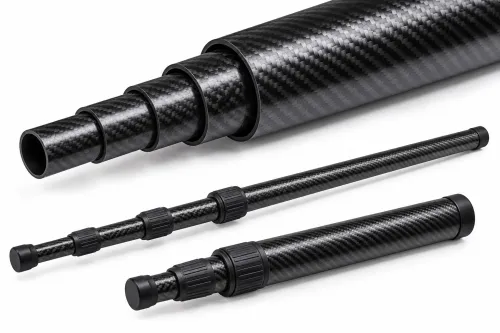
An adjustable carbon fibre pole for access problems in Mumbai is useful where traffic, parked vehicles, tight building setbacks, weak ground or monsoon water prevents a lift, scaffold or truck from being positioned safely.
| Site constraint | Why the pole helps |
|---|---|
| Narrow lane or balcony | Works through a small access path without occupying the road |
| Congested rooftop or service shaft | Reaches over plant, parapets and ducting from a clear standing point |
| Wet or unstable ground | Avoids placing lifting equipment on flooded or weak surfaces |
| Traffic or parked vehicles | Reduces lane closure, rigging and equipment setup |
Carbon/epoxy laminates typically weigh 1.5–1.7 g/cm³, compared with roughly 2.7 g/cm³ for aluminium and 7.8 g/cm³ for steel. That low mass matters when you hold the pole for minutes or reposition it repeatedly.
An adjustable carbon fibre pole in Mumbai can reduce access equipment and setup time, but it does not support your body or provide fall protection.
Do not choose by headline reach alone. Under a point load, bending and tip deflection rise approximately with the cube of unsupported length; a longer pole also catches more wind. Specify usable working length, collapsed length, tool mass and tip deflection, then check that the attachment remains controllable at the required angle.
Match the tip attachment to the job you need to perform
A carbon-fibre pole for difficult reach works only when the tip attachment matches the force and movement the task demands. Set the section length and pole angle from a stable ground stance; control fine positioning with wrist movement at the base, or with a rotating tip interface when the tool must turn.
A fixed interface suits tools that remain aligned.
- Fit a brush, squeegee, roller or vacuum head for façade and window cleaning. Push with controlled pressure, keeping the pole angle low enough to limit deflection and twisting.
- Fit an inspection camera with a live screen for cracks, drains, roof edges and inaccessible equipment. Use small base or wrist movements, then rotate the tip only when the camera head requires orientation.
- Fit a hook, eye or manufacturer-approved rescue attachment for placing an anchorage point from a distance. Use a fixed or positively locking interface; do not improvise a gripping clamp.
- Fit a cable guide, clamp or sensor bracket for routing wires and positioning instruments. Choose a rotating interface for directional placement and a fixed one when alignment must not change.
A telescopic pole for maintenance access transfers every tool reaction to the operator: pushing a brush or pulling a cable creates a base moment that grows with pole length. Tell the buyer the tool mass, centre-of-gravity offset, operating angle, required rotation and torsional control. Require a compatible interface and known load rating for every attachment.
Use an extended pole without creating a new hazard
A safe operating sequence for an adjustable carbon fibre pole in Mumbai starts with controlling people, electricity and the pole itself before extension.
1. Set an exclusion zone below and around the work area. Appoint a second worker as a spotter to watch pedestrians, vehicles, nearby structures, overhead conductors and exposed electrical equipment.
2. Before extending, inspect the laminate, end fitting, attachment, collars, locks and section edges. Reject the pole for impact marks, cracks, whitening, delamination, crushed tubes, loose fittings or dirt, water and salt contamination.
3. Stand on stable, dry ground and extend only as far as the task requires. Confirm the specified section overlap at every joint, then engage each positive mechanical lock or collar fully. Never rely on an invisible friction setting.
4. Stay within the manufacturer’s maximum working extension and attachment load. Use tool retainers where designed to control dropped objects, and maintain the utility’s specified clearance from conductors and exposed electrical equipment.
5. Treat carbon fibre as conductive. Do not use an ordinary carbon pole as an insulated live-line tool; ASTM F711 covers fibre-reinforced plastic live-line tools but does not make this assembly compliant. Require named compliance, test voltage and certification for the complete pole, fittings and work method.
6. Stop for strong wind, lightning, slippery surfaces or poor footing. After wet, gritty or salty work, clean and dry every section before collapse, drain the joints, and follow the manufacturer’s joint-cleaning procedure.
Specify working reach, load and transport fit—not just maximum length
Choose a pole from the site geometry, not its advertised maximum. Measure target height, horizontal gap, base clearance, obstruction path and safe stand-off distance; add operator reach and account for the working angle. Pole length is not working height.
A telescopic pole for maintenance access can span a gap yet remain unusable if its base blocks pedestrians, its collapsed length cannot pass through a lift or stairwell, or its tool strikes glazing or adjacent structures.
Request these figures in writing:
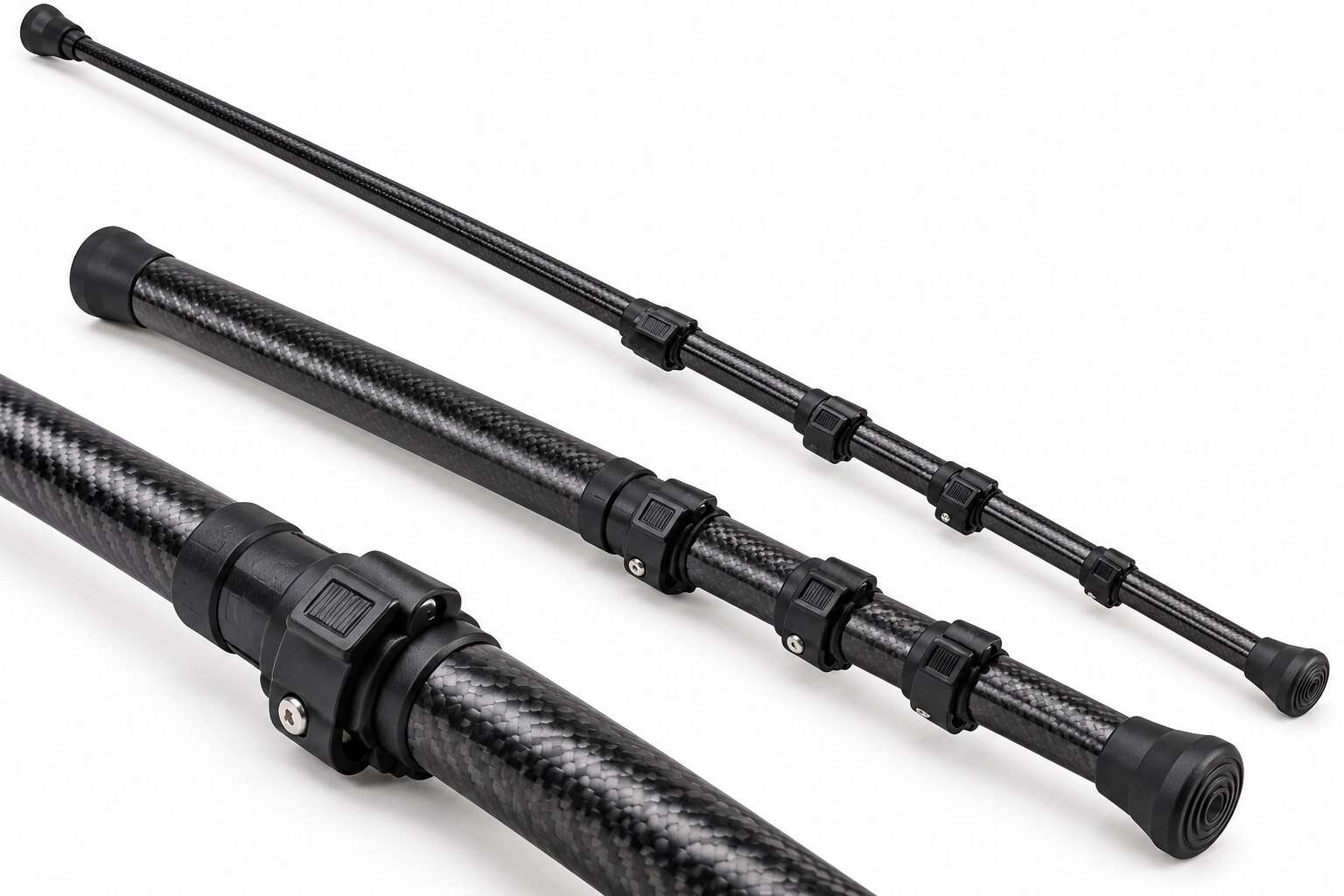
- Working-length range, collapsed length, section count, pole mass, section diameter and grip dimensions.
- Minimum section overlap, lock type, maximum attachment mass, allowable tip deflection, working-load and tip-load limits, torsional play and attachment interface.
- Ratings at every extension stage, not only with the pole fully retracted.
- Wet-service cleaning and drainage instructions, isolated or coated metal fittings, and galvanic-corrosion protection where carbon contacts aluminium or steel in salty water.
Excessive unsupported length increases deflection and wind sensitivity; short overlap invites joint slip, local buckling or instability. Specify the intended attachment and working angle during testing.
| Lock type | Main concern | Evidence to request |
|---|---|---|
| Positive mechanical lock | Pin or latch may be incompletely engaged | Proof-load and slip-test method |
| Friction collar | Holding force depends on tightening and contamination | Measured slip test at each extension stage |
| Twist-lock | Sections can rotate or loosen | Torque, proof-load and repeated-cycle test results |
Decide when a pole is the right access system and what to put in the purchase brief
Select a pole for remote inspection, light cleaning, sensor placement or controlled attachment work when the operator needs no body support.
An adjustable carbon fibre pole for access problems in Mumbai is the wrong choice when the task demands heavy tools, high pulling forces, prolonged two-person operation, strong wind, unstable ground, certified fall protection, rescue equipment or live-line work requiring electrically rated fibreglass.
| Option | Choose it when | Do not use it when |
|---|---|---|
| Pole | The operator stays on the ground and controls a light attachment | Workers need body support, both hands or sustained force |
| Rope access, scaffolding or MEWP | Workers must stand at height, carry tools or remain at the façade | The task is a brief remote inspection |
| Ladder | The task is short, stable and compliant | The surface, height or duration makes footing uncertain |
| Drone | Visual inspection is the main need and flight conditions permit it | You need contact, cleaning or attachment placement |
| Water-fed pole | Continuous water delivery is part of cleaning | Dry inspection or attachment work is required |
| Permanent access system | Maintenance is repeated and predictable | Access needs are occasional and changing |
Give a custom adjustable pole supplier in Mumbai a site drawing and specify collapsed transport length, working range, section count, minimum overlap, lock type, mass, attachment geometry, tool load, deflection, torsional play, wet or dirty cleaning, electrical conductivity and replacement sections.
Require repeated extension-retraction cycles with the intended attachment, then a static proof-load test at the longest working configuration.
Carbonext India Pvt Ltd belongs in the comparison only when it documents those site-specific figures rather than quoting maximum reach alone.
Related products
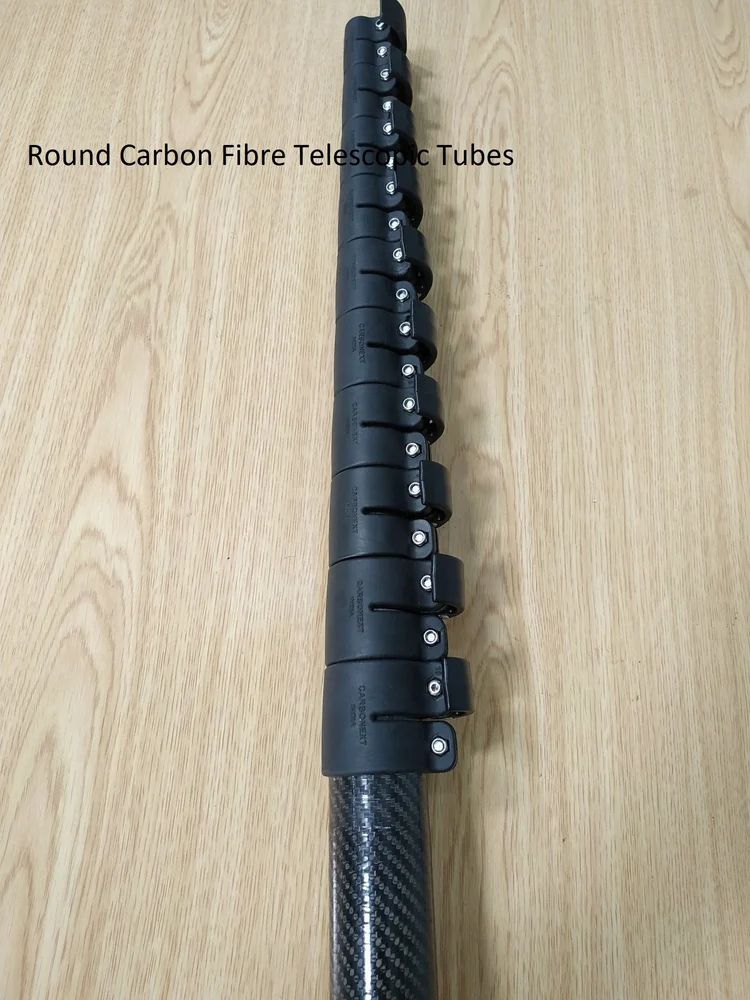
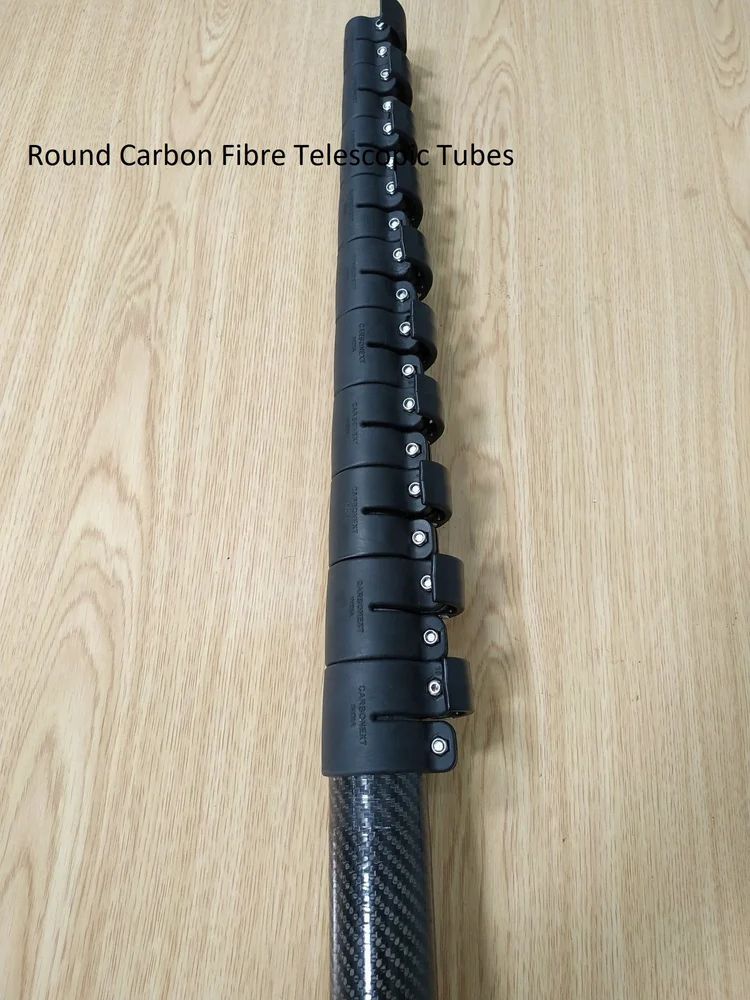 | Telescopic Pole Carbon Fibre Adjustable Telescopic Pole Material Carbon Fibre Usage/Application Industrial Color Carbonext Brand Carbonext Country of Origin Made in India Weight 6 kg Colour Black Height 70... View product → |
 | Telescopic Pole Maximum Length 11 meter Usage/Application Rescue Color Black Packing Type Box Country of Origin Made in India Telescopic pole is light in weight,... View product → |
Frequently asked questions
Where can an adjustable carbon fibre pole solve access problems in Mumbai?
It suits high-rise façades, congested rooftops, balconies, service shafts and narrow lanes where ladders, lifts or scaffolding are difficult to position.
How do you choose the right tip attachment for a telescopic pole?
Match the attachment to the task and surface: use cleaning heads for façades and glazing, inspection tools for visual checks, and purpose-built fittings for maintenance equipment.
How can you use an extended pole without creating a new hazard?
Check overhead services, maintain a controlled exclusion zone, secure the tool, extend sections from stable ground and stop work when wind or site movement makes control unsafe.
What should you include in a custom adjustable pole purchase brief?
Specify working reach, collapsed length, tool load, tip interface, section locking method, operating environment and transport constraints rather than maximum length alone.
Related products
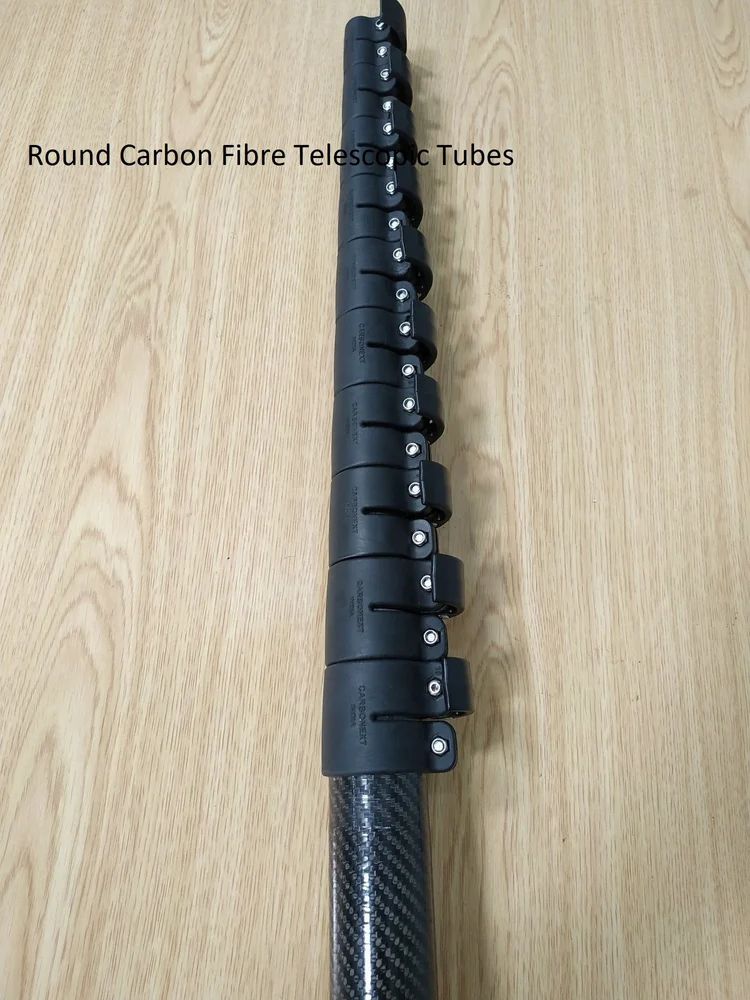 | Telescopic Pole Warranty 3 Months Color Black Dimension 20 Feet Onwards Surface Type Carbon Fibre Country of Origin Made in India Material Carbon Fibre Surface... View product → |
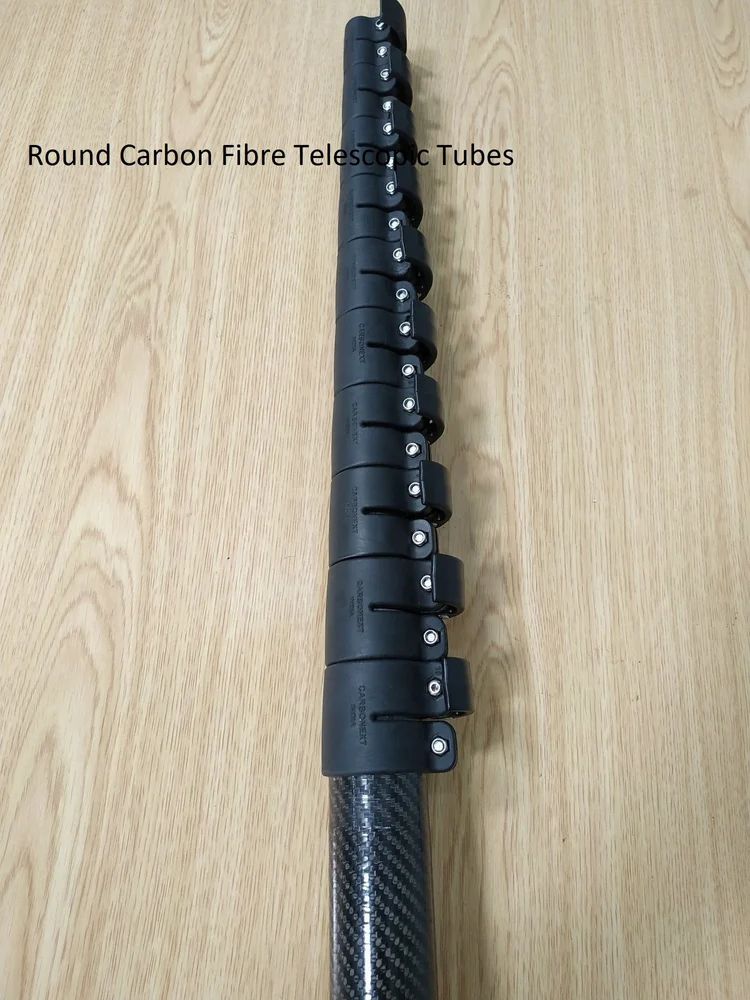 | Telescopic Pole Black Telescopic Extension Poles Material Carbon Fiber Brand Carbonext Warranty 6 Months Usage/Application Industrial Length 80 feet Country of Origin Made in India Packaging Type... View product → |
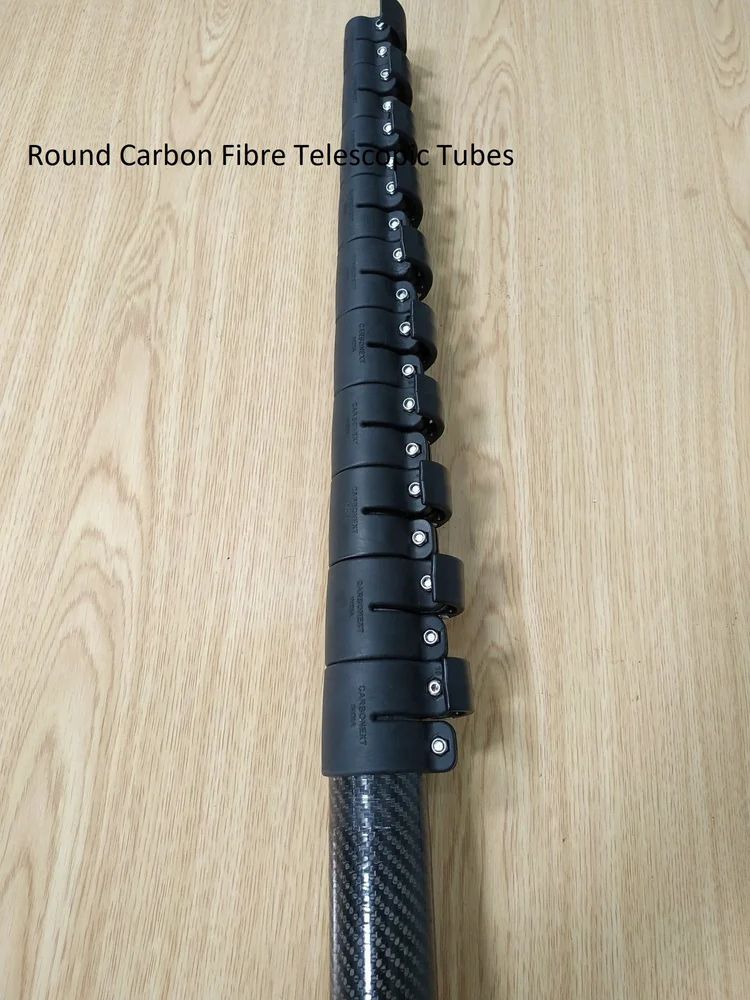 | Telescopic Pole Round Carbon Fibre Telescopic Tubes Design Carbon Fibre Size 20 Feet Usage/Application Cleaning Window Features Strong Brand Carbonext Color Black Packaging Type Box We are engaged in... View product → |
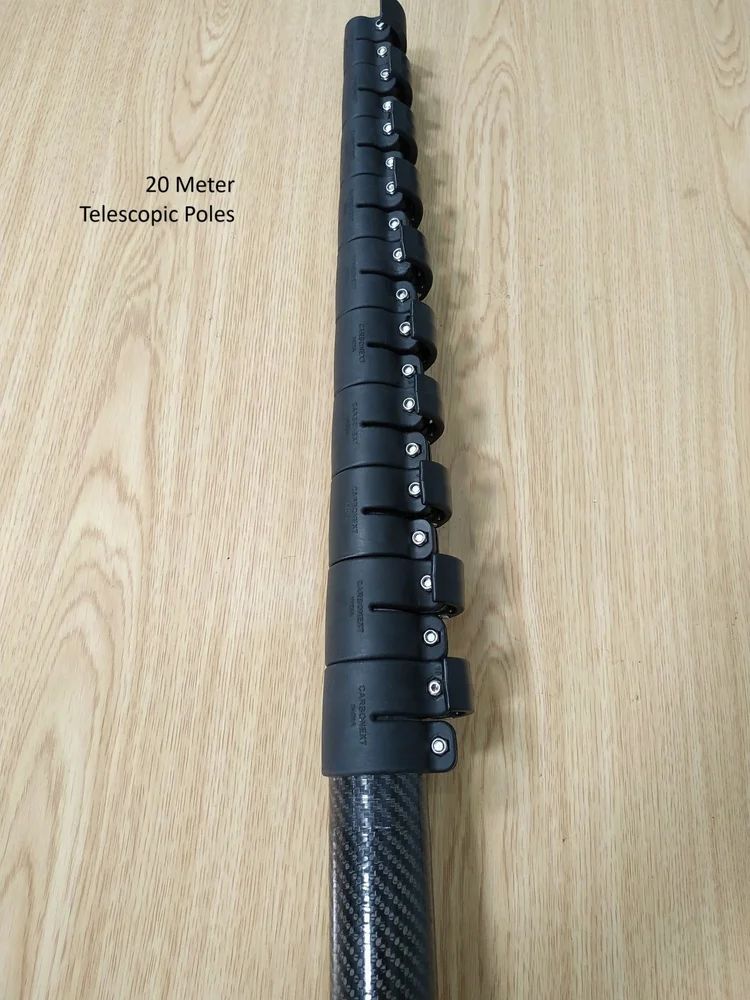 | Telescopic Pole Usage/Application Pool Cleaning Color Black Brand Carbonext Packing Type Box Length 23 meter We are engaged in offering a wide range of 20 Meter... View product → |
Keywords